Precision at Scale: A Guide to Long-Stroke Robot Linear Tracks
Introduction
As industrial automation continues to scale up, manufacturers are increasingly deploying robots to handle larger work envelopes and higher production volumes. In applications such as welding, cutting, and material handling, standard robot reach is often not enough. This is where long-stroke robot linear tracks play a critical role.
By extending robot travel distance while maintaining positioning accuracy, long-stroke linear tracks enable manufacturers to achieve precision at scale—combining large working ranges with consistent motion control.
What Is a Long-Stroke Robot Linear Track?
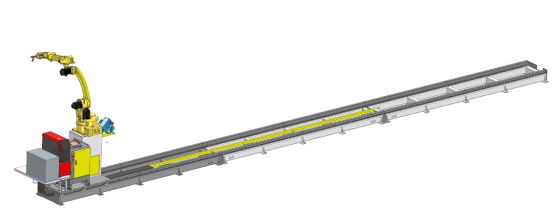
A robot linear track (also known as a robot travel rail or 7th axis) is a servo-driven motion system that allows an industrial robot to move linearly along a rail.
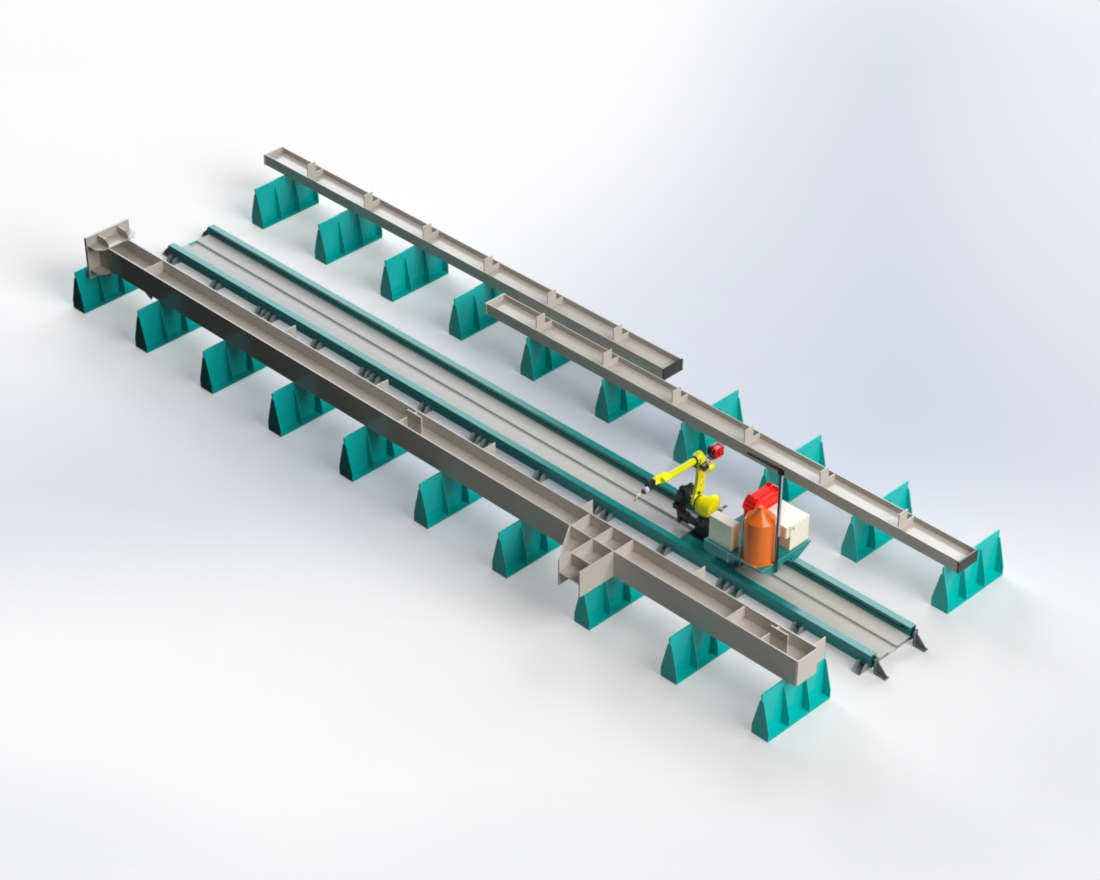
A long-stroke configuration is designed for extended travel distances, typically several meters or more, enabling robots to serve multiple workstations or large workpieces.
These systems function as synchronized external axes, allowing coordinated motion between the robot and the linear track.
Key Advantages of Long-Stroke Robot Linear Tracks
Extended Working Envelope Without Compromising Accuracy
Long-stroke linear tracks significantly expand the robot’s reach while maintaining stable positioning accuracy. High-rigidity rail structures and precision servo drives ensure smooth motion across the entire stroke length.
Improved Production Efficiency and Throughput
By allowing a single robot to service multiple stations or long weld seams, robot linear tracks reduce the need for additional robots. This lowers system cost while increasing overall line efficiency.
Flexible Cell Layout and Scalability
Long-stroke designs support modular expansion. Manufacturers can start with a basic stroke length and extend the rail as production demands grow, making them ideal for scalable automation systems.
Precision Considerations in Long-Stroke Applications
Achieving precision over long distances requires careful system design. Key factors include:
- Rail straightness and structural rigidity
- Servo motor and gearbox selection
- Encoder resolution and motion control tuning
- Proper load and center-of-gravity calculation
High-quality robot linear tracks are engineered to maintain repeatability and motion stability even under continuous operation and heavy payloads.

Typical Applications
Long-stroke robot linear tracks are widely used in:
- Robotic welding of large structures and long assemblies
- Automotive body and frame production lines
- Steel fabrication and heavy manufacturing
- Multi-station robotic automation cells
These applications benefit from the combination of long travel distance and synchronized robotic motion.
Integration with Robotic Automation Systems
Modern robot linear tracks are designed for seamless integration with major industrial robot brands. Acting as a 7th axis, the track can be fully synchronized with the robot controller, enabling smooth coordinated motion and optimized process paths.
Conclusion
Long-stroke robot linear tracks enable manufacturers to achieve large-scale automation without sacrificing accuracy or reliability. By extending robot reach, improving layout flexibility, and supporting synchronized motion control, these systems deliver true precision at scale for modern robotic applications.
Contact us to learn more about long-stroke robot linear track solutions and system integration options.
 Reducing Cycle Times: The Role of Headstock-Tailstock Positioners in Automation
 How Robotic Welding Positioners Improve Weld Penetration and Consistency
 1-Axis vs. 3-Axis Positioners: Which One Does Your Welding Cell Need?
 Extending the Work Envelope: How Linear Tracks Boost Productivity in Large-Scale Fabrication
